
Black Radio in 1940s Chicago: The Rise of Destination Freedom
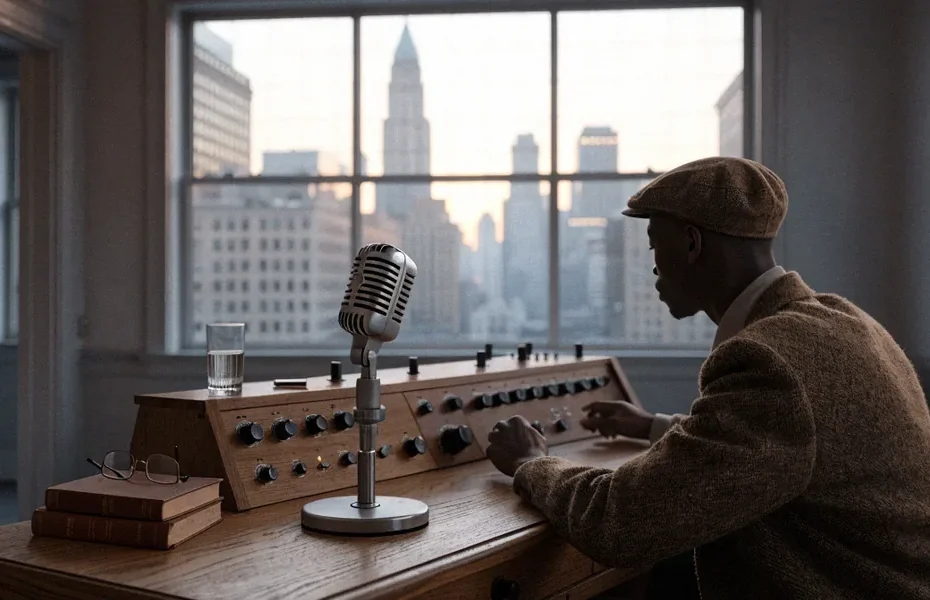
It’s a winter evening in Chicago, 1948. The dishes are washed, the children are hushed, and the family gathers around the wireless. But tonight, they aren’t tuning in for comedy or a soap opera. They’re waiting for Richard Durham’s Destination Freedom, a series that will tell them the stories their schoolbooks left out. As the announcer’s voice crackles through the speaker, a question hangs in the air: how did this groundbreaking series redefine Black radio history?
The Golden Age of Radio and Chicago’s Black Community

To understand Destination Freedom, we first need to picture the world it entered. By the 1940s, Chicago was a major hub for Black culture and commerce, shaped in large part by the Great Migration. Between roughly 1916 and 1970, millions of African Americans left the rural South for northern cities, and Chicago was one of the most popular destinations. The Black population of the city swelled from around 44,000 in 1910 to over 230,000 by 1930, and it kept climbing through the war years.
Bronzeville: The Heart of Black Chicago
Many of these new arrivals settled in a neighbourhood known as Bronzeville, on Chicago’s South Side. Bronzeville became a self-contained cultural and economic powerhouse — home to the Chicago Defender, one of the most influential Black newspapers in the United States, as well as theatres, churches, jazz clubs, and thriving Black-owned businesses. It was a place where Black talent, ambition, and political consciousness converged.
Radio as a Lifeline and Entertainment
Radio was the dominant mass medium of the era. Stations like WGN and WMAQ broadcast from Chicago to millions of listeners across the Midwest, and occasionally featured Black performers — usually as musicians or comic sidekicks. Black audiences tuned in for entertainment, news, and a sense of connection to the wider world, but they rarely heard their own history and heroes portrayed with dignity. That gap was about to be filled.
Richard Durham: The Visionary Behind Destination Freedom
Richard Durham was a Black writer, journalist, and activist whose career embodied the spirit of Bronzeville. He was born in 1917 in Raymond, Mississippi, and his family moved to Chicago when he was a child. Durham grew up surrounded by the intellectual and political ferment of the South Side, and he channelled that energy into writing that challenged racial injustice.
Durham’s Early Life and Influences
Durham’s formative years were shaped by the Great Depression, the rise of organised labour, and the activism of figures like A. Philip Randolph. He worked as a journalist and editor, contributing to the Chicago Defender — the same newspaper that had encouraged Black southerners to migrate north. Writing for the Defender taught him how to reach a mass Black audience with clear, compelling prose, and it sharpened his commitment to telling authentic Black stories rooted in history and lived experience.
From Print to Airwaves: Durham’s Transition
After serving in the Second World War, Durham returned to Chicago with a bold idea: a radio series devoted entirely to African American history and achievement. He pitched the concept to station WMAQ, an NBC affiliate, and in 1948 Destination Freedom went on air. It was a remarkable achievement — a Black writer producing a weekly network drama about Black history at a time when such programming was virtually unheard of.
Destination Freedom: A Revolutionary Radio Drama
Destination Freedom was unlike anything else on American radio. Each episode was a self-contained docudrama, dramatising the life of a Black figure — some famous, some forgotten — and drawing a lesson about courage, justice, and the ongoing struggle for freedom. The series ran from 1948 to 1950, producing more than ninety episodes.
Format and Structure of the Series
Each half-hour episode blended narration, dialogue, and music to bring its subject to life. Durham’s scripts were tightly written, emotionally charged, and carefully researched. A typical episode followed a clear arc:
- An opening narration setting the historical scene
- Dramatised scenes with actors voicing the central figure and supporting characters
- Musical interludes that underscored the mood
- A closing reflection tying the story to contemporary struggles for equality
The series drew on a talented pool of Black actors and musicians, many of whom would go on to distinguished careers. It also featured original music that gave each episode a distinctive atmosphere.
Key Episodes and Their Impact
Durham chose his subjects carefully, mixing well-known heroes with figures white America preferred to ignore. Among the most powerful episodes were:
- ‘The Denmark Vesey Story’ — a dramatisation of the thwarted 1822 slave rebellion in Charleston, South Carolina, led by a free Black carpenter. The episode presented Vesey not as a footnote but as a freedom fighter.
- ‘The Story of Harriet Tubman’ — a vivid account of the Underground Railroad conductor’s courage and cunning, giving listeners a heroine to admire.
- Episodes on figures like Crispus Attucks, Frederick Douglass, and Ida B. Wells, each framed as part of a continuous struggle for liberation.
For Black listeners in Bronzeville and beyond, hearing their own history treated with seriousness and artistry was transformative. For white listeners, it was an education.
Challenges and Censorship in 1940s Chicago Radio
Despite its critical success, Destination Freedom faced constant pressure. Durham was navigating a medium controlled almost entirely by white executives, sponsors, and advertisers, many of whom were uncomfortable with the series’ political content.
Sponsor Pressures and Racial Bias
Sponsors were wary of a show that tackled slavery, rebellion, and racial injustice head-on. Some episodes were softened or delayed; others drew complaints from listeners who found the material ‘divisive’. Durham had to fight for every script, often rewriting to satisfy nervous station managers while preserving the core of his message.
The Fight for Air Time
The series was briefly cancelled in 1949, a decision that reflected both budget concerns and political discomfort. Thanks to listener protests and support from within the industry, it was revived and moved to WMAQ, where it continued until 1950. The struggle over Destination Freedom was a microcosm of the broader racial tensions shaping post-war America.
The Legacy of Destination Freedom in Black Radio History
Though Destination Freedom ended its original run in 1950, its influence echoed for decades. It proved that Black history could command a mainstream audience and that radio drama could be a tool for education and empowerment.
Influence on Subsequent Black Radio
Later Black radio programmes — from civil rights-era broadcasts to contemporary podcasts like Seeing White and 1619 — owe a debt to Durham’s example. He demonstrated that storytelling rooted in Black experience could be both popular and politically potent.
Modern Revivals and Archives
Today, the surviving episodes of Destination Freedom are preserved in the Library of Congress and available through online archives. They are studied by historians, replayed by enthusiasts, and cited by podcasters who see Durham as a pioneer. His scripts remain a model of how to make history come alive.
Destination Freedom and the UK: Transatlantic Echoes
Although Destination Freedom was made in Chicago, its reach extended across the Atlantic. In the 1950s, the BBC broadcast episodes of the series to British audiences, introducing listeners in London and beyond to Durham’s vision of Black history.
BBC Broadcasts and UK Reception
The BBC’s decision to air Destination Freedom was significant. At a time when British radio rarely addressed Black history or the experiences of the Windrush generation — the Caribbean migrants who arrived in Britain from 1948 onwards — these broadcasts offered a rare window into African American life and struggle. They resonated with Black Britons navigating their own challenges of racism and belonging.
Parallels with British Black Media
The series also foreshadowed later British Black media initiatives, from the rise of Black British radio in the 1960s and 1970s to contemporary podcasts and documentaries exploring race and identity. Durham’s insistence on telling authentic stories from within the community remains a guiding principle for Black media makers on both sides of the Atlantic.
FAQ
What was Destination Freedom?
Destination Freedom was a groundbreaking American radio drama series created by Richard Durham and broadcast from 1948 to 1950. It dramatised the lives of African American historical figures and explored themes of freedom, justice, and resistance.
Who was Richard Durham?
Richard Durham was a Black writer, journalist, and activist from Chicago. He worked for the Chicago Defender before creating Destination Freedom, and he is remembered as a pioneer of Black radio drama.
Why was Destination Freedom important for Black radio history?
It was one of the first network radio series to present Black history with dignity and artistry, reaching both Black and white audiences. Its success paved the way for later Black radio programming and inspired generations of storytellers.
Did Destination Freedom air in the UK?
Yes. In the 1950s, the BBC broadcast episodes of the series to British audiences, where it resonated with the Windrush generation and others interested in Black history and civil rights.
Where can I listen to Destination Freedom today?
Many episodes are preserved in the Library of Congress and are available through online archives and podcast platforms. They remain a valuable resource for anyone interested in Black radio history and African American history.
Destination Freedom was never just a radio show. It was a bold act of resistance — a weekly declaration that Black lives, Black history, and Black stories mattered. From the streets of Bronzeville to the airwaves of the BBC, Richard Durham’s vision continues to inspire storytellers on both sides of the Atlantic, reminding us that the fight for freedom is always a story worth telling.