
Preserving Old Broadcast Recordings: Our Mission to Keep Black Radio History Alive
Pick up a lacquer transcription disc from the late 1940s and you will feel how precarious the whole story is. The coating is barely thicker than a coat of paint, it scratches if you look at it wrong, and the aluminium core underneath has often started to corrode after seventy-odd years in a damp loft or a hot garage. These discs carried some of the most important writing in American radio, including every episode of Destination Freedom, and most of them were never meant to survive. They were cut for a single broadcast, played once, and filed away. That fragility is exactly why we started this blog, and why we spend our evenings hunting down old broadcast recordings before they turn to dust.
Why Old Broadcast Recordings Are at Risk
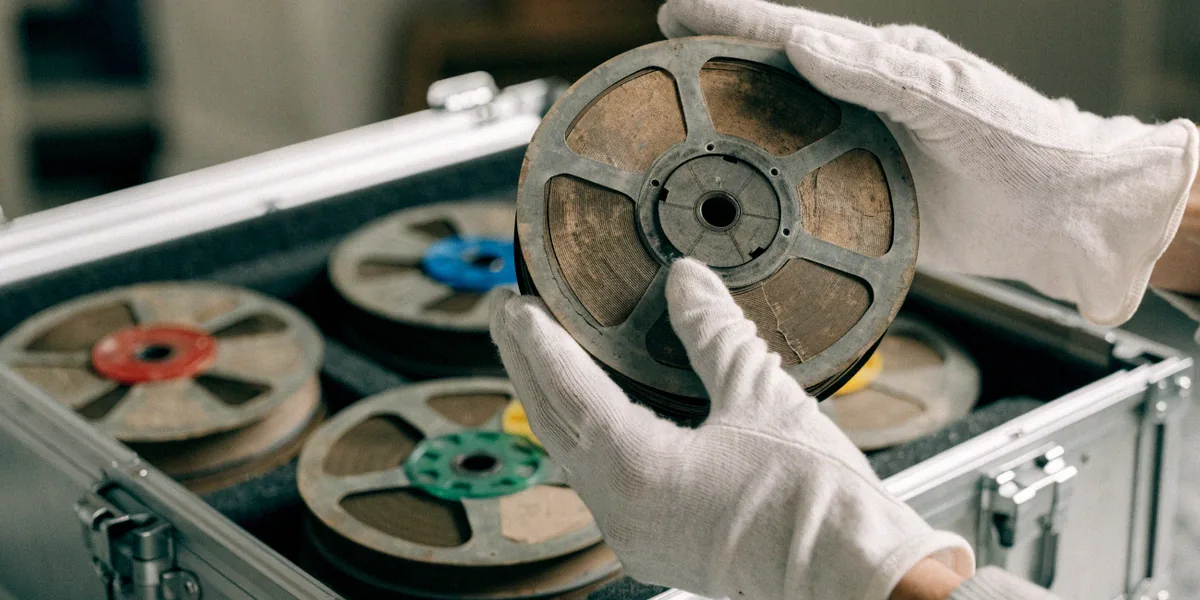
Sound carriers from the mid-twentieth century were built for transmission, not for the long haul. A disc that sounded fine through a 1949 loudspeaker can be unplayable today, and the window for saving what remains is closing fast.
The fragility of transcription discs and magnetic tape
Transcription discs, the format used to distribute syndicated shows like Destination Freedom to stations across the United States, consist of a thin lacquer layer over a metal or glass base. The lacquer shrinks, cracks, and flakes. The base rusts or shatters. Many discs also suffer from “delamination”, where the recording surface simply lifts away from the core, taking the audio with it.
Magnetic tape brought its own problems. Acetate tape from the 1950s and 1960s suffers from “vinegar syndrome”, a chemical breakdown that gives off a sharp acidic smell and warps the reels. Later polyester tape is more stable but prone to sticky-shed syndrome, where the binder absorbs moisture and clogs playback heads. Reel-to-reel machines that can play these tapes safely are now rare, and the engineers who know how to align them are rarer still. In the UK, the British Library Sound Archive has spent decades warning about exactly this combination of decaying media and disappearing playback equipment, and its collections show how quickly formats become unreadable once the machines stop being made.
How neglect and climate affect archived audio
Storage conditions decide whether a recording lasts fifty years or five. Heat accelerates chemical breakdown in both lacquer and tape. Humidity encourages mould, which etches into the recording surface and cannot always be cleaned off. Repeated playback on mistracked equipment grinds away the grooves themselves.
Just as damaging is simple neglect. Boxes of discs sit in basements, attics, and church storage rooms because nobody realises what they are. A station that closed in 1962 leaves its library to whoever clears the building, and the tapes go into a skip. Every year we lose recordings not to a single disaster but to a thousand small decisions to leave them where they are.
The Legacy of Destination Freedom and Richard Durham
Among all the material at risk, the surviving episodes of Destination Freedom sit at the centre of our work. The series ran from 1948 to 1950, written almost entirely by Richard Durham and produced in Chicago for station WMAQ.
Richard Durham’s writing and the series’ cultural impact
Durham was a journalist, editor, and activist who had already made his name in the Black press before he turned to radio. What he did with Destination Freedom was unusual for its time: instead of presenting African American history as a footnote, he built each episode around a full dramatic portrait of figures such as Frederick Douglass, Harriet Tubman, Ida B. Wells, and Crispus Attucks. The scripts treated Black lives as epic subject matter, written with the same craft and seriousness that the BBC was applying to its own radio drama in the same period.
That comparison is not idle. While BBC radio drama was establishing the conventions of the feature and the verse play for a national audience, Durham was doing something comparable for a syndicated American programme aimed at Black listeners and open-minded white ones. His dialogue carried the rhythm of protest speeches, and he refused to soften the politics. The series is now widely cited as a landmark in Black radio history, and in African American history more broadly, because it put radical Black biography on the airwaves years before the civil rights movement reached its peak.
Key episodes and their survival status
Not every episode survived, and the gaps tell their own story. Among the material we track most closely:
- “The Story of Denmark Vesey”, Durham’s account of the 1822 Charleston plot, exists in circulation but only through copies of varying quality.
- “Citizen Toussaint”, on Toussaint Louverture and the Haitian Revolution, is one of the better-preserved episodes and a frequent starting point for new listeners.
- “A Woman’s Place”, on Ida B. Wells, survives in a form that has clearly passed through several generations of dubbing.
- Several late-1949 and 1950 episodes are listed in scripts and press notices but have no known audio, and we treat them as lost until a disc turns up in a private collection.
Each surviving disc is a small miracle of someone deciding, decades ago, not to throw it away.
How Our Team Approaches Preservation
We are not a laboratory and we do not pretend to be one. What we do is find recordings, document them properly, and make sure the digital copies outlive the physical media.
Sourcing and cataloguing rare recordings
Our sourcing is deliberately slow. We talk to private collectors who bought discs at estate sales, to former engineers who kept tapes from stations that no longer exist, and to UK institutions including the National Sound Archive, whose holdings overlap with ours in surprising ways. When a recording arrives, we log everything before we touch it: the label text, the matrix number, the physical condition, any handwriting on the sleeve, and the name of the person who supplied it. Provenance matters, because a disc with a documented chain of custody is far more useful to researchers than an anonymous file.
Digitisation, cleaning, and metadata standards
For playback we use restored equipment where possible, and for editing we rely on Audacity, the open-source audio editor. It handles the work we need without locking our files into a proprietary format: capturing at high resolution, removing clicks and surface noise carefully rather than aggressively, and exporting archival masters alongside listening copies.
Metadata is where a lot of amateur digitisation falls down. We follow a simple discipline:
- Capture at 24-bit, 96 kHz where the source justifies it, and never apply irreversible noise reduction to the master file.
- Store an unedited preservation master, a lightly cleaned access copy, and a compressed streaming version separately.
- Record titles, dates, episode numbers, writers, performers, source institution or donor, and a plain-language condition note.
- Back everything up in at least two locations, with checksums so we can detect silent corruption later.
That way, if a future archivist disagrees with our cleaning choices, they can go back to the raw capture and start again.
Challenges in Preserving Black Radio History
Goodwill is not the limiting factor. Money, law, and institutional priorities are.
Copyright and rights clearance for old radio
Scripts, performances, and recordings can each carry separate rights, and for a syndicated series like Destination Freedom the ownership picture is genuinely messy. Some episodes may still be controlled by successor companies; others may be effectively orphan works with no traceable rights holder. In the UK, the same problem affects decades of domestic radio output. We can preserve a recording for private study, but publishing it openly requires clearance we often cannot obtain, which is why we focus on documentation, context, and clips within fair dealing rather than full uploads.
Funding and institutional neglect
Sound preservation in the UK has never been funded at the level its scale demands. The British Library Sound Archive holds one of the largest collections in the world, yet it has repeatedly warned about the backlog of un-digitised and deteriorating material. Black radio history sits at a particular disadvantage: much of it was syndicated, independently produced, or broadcast on stations whose archives were never considered worth keeping. When budgets tighten, the material with the least institutional backing disappears first, and that means African American history loses its own recorded voice.
How You Can Help Preserve Old Broadcast Recordings
If you have read this far, you are already the kind of person who can make a difference. Here is what actually helps.
Donating or lending recordings to archives
Do not attempt to clean a fragile disc yourself, and do not play it to “see what’s on it”. Contact an archive first. Institutions such as the British Library Sound Archive and the National Sound Archive can advise on condition and, in many cases, digitise a loan and return the original. If you would rather keep the item in the family, a high-quality loan arrangement is still far better than a disc sitting in a warm room. If you are unsure where to start, message us and we will point you towards the right contact.
Advocating for sound preservation funding
Preservation survives on public pressure as much as on grants. You can:
- Support the Radio Preservation Task Force, which coordinates efforts to locate and save American radio heritage, and cite its work when writing to funders or representatives.
- Write to UK funding bodies and your MP about audiovisual heritage budgets, using the British Library’s own warnings as evidence.
- Share our blog posts and episode notes with anyone researching Black radio history, African American history, or mid-century radio drama.
- Volunteer transcription or cataloguing time if you have the skills, because metadata is what makes a recording findable.
None of this is glamorous. All of it works.
FAQ
What is Destination Freedom and why does it matter?
Destination Freedom was a US radio drama series written by Richard Durham and broadcast between 1948 and 1950. It dramatised the lives of Black historical figures with unusual political directness, and it stands as one of the most significant bodies of writing in Black radio history.
Can I listen to surviving episodes of Destination Freedom today?
Many episodes circulate in restored or semi-restored form through archives and collector communities. Quality varies considerably depending on how many generations of copying a recording has been through. We document what is available and note where gaps remain.
How should I store old transcription discs or tapes if I own some?
Keep them cool, dry, and upright, away from sunlight and radiators, and do not play them on untested equipment. Then contact an archive. Storage buys time; professional digitisation is what actually saves the audio.
Why is copyright such a problem for old radio recordings?
Rights in a broadcast can be split between script, performance, and recording, and many mid-century production companies no longer exist. When no rights holder can be found, the recording becomes an orphan work that is hard to publish legally, even when everyone agrees it should be heard.
What can UK listeners do to help?
Donate or lend recordings to the British Library Sound Archive or the National Sound Archive, support the Radio Preservation Task Force, and push for sound preservation funding. Sharing our resources with researchers is another simple but genuinely useful step.
Every one of these recordings is a piece of Black radio history that exists only as long as the physical object or its digital copy survives. We cannot save all of it, but we can refuse to let it disappear quietly. If you have a disc, a tape, or a memory of hearing Destination Freedom on air, we would love to hear from you.